


Introduction
The lack of parking spaces in cities is a problem that affects millions of Italians every day. In our country, we are very fond of cars and prefer them to any other transport solution. This leads to overcrowding of vehicles in all those urban centers where there are not enough parking spaces to guarantee parking for every driver.
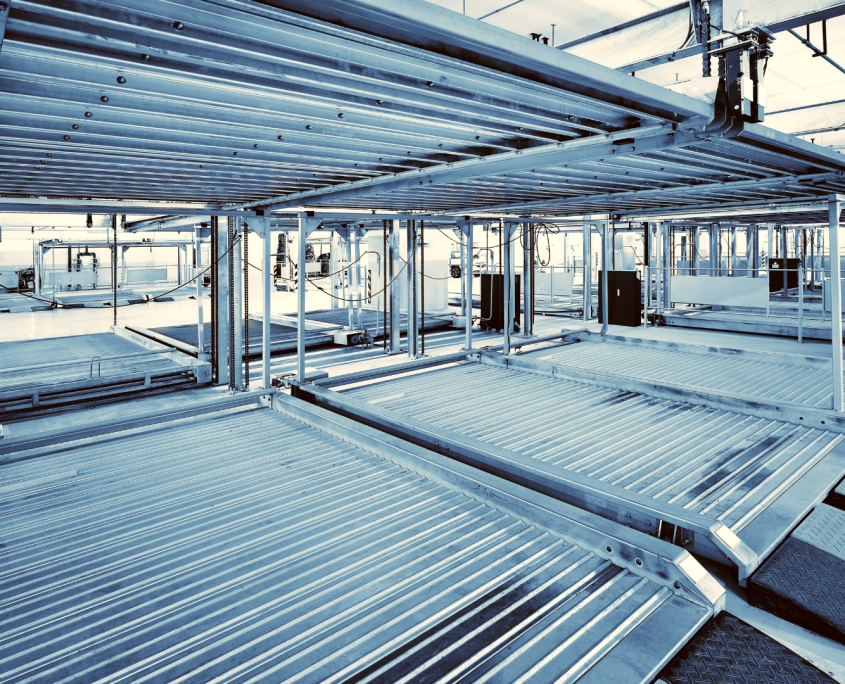
To overcome this limitation, it is possible to opt for automated underground parking, areas in which you entrust your car to a special operator, or to a dedicated computer system that automatically places and looks after it while it is not being used.
Automated parking systems guarantee much greater spatial efficiency than ramp systems. It is estimated that, given the same size, a parking area of this type can accommodate up to 10 more cars, since the vehicle movement is entrusted to special moving platforms for cars and no traffic lanes are needed. The driver will not have to perform any maneuvers to position his car, nor move on foot between the floors, simply leaving it on the mobile support. This translates into more time saved.

Moving platforms and lifting systems
Every underground automated parking lot must comply with the regulations that regulate building excavations and be positioned in areas free from the presence of aquifers or archaeological remains. Once this evaluation has been completed and the decision to create an automatic parking area has been made, it is necessary to establish, based on the size of the site and the available budget, whether to use a moving platform or a lift to move the vehicles.
The simplest and most economical solution is the automated platform. It moves horizontally or vertically, a few meters, along special tracks that transfer it inside the parking lot.
The automatic lifting system, on the other hand, consists of a lift. Instead of moving people from one landing to another, it moves cars from level to level.
This solution is more complex than the previous one and requires a larger investment.
The use of automatic systems such as those described allows you to save all the space normally dedicated to maneuvering lanes. The Ministerial Decree of February 1, 1986 prescribes a minimum width of 4.50 meters for these spaces, which becomes 5.00 m in the sections in front of the parking box or the parking spaces orthogonal to the direction of travel. Common sense rules, then, provide for an increase of 0.5 – 1 m on these minimums, given the tendency to constantly increase the size of the cars. By assigning automated mechanical arms the task of moving cars into the underground parking spaces designated for them, all the maneuvering space can be saved and used to place additional parking spaces for cars.
Technology and safety in automated underground parking lots
Inside automated underground parking lots, there are cutting-edge technological sensors with the specific task of supervising the conditions of the parking area: how many parking spaces have been occupied and how many are still free? Is the movement system reading the situation of the parking spaces filling correctly? Is everything proceeding at the right speed and are the vehicles moving correctly? These hyper-technological sentinels monitor everything and communicate it to the computer system responsible for managing the underground parking lot.
This virtual guardian transmits the information relating to occupancy to the human operators on site, or remotely, on a display, who can always keep the situation under control and intervene quickly if necessary, as well as to users who wish to stop their car and can check whether there is space available in the chosen parking area. The technology of an underground automatic parking lot generally involves the placement of one or more of the following detectors:
- infrared sensors: they measure the heat of objects, such as cars, and are used to monitor the movement of vehicles;
- ultrasonic sensors: used to capture sound waves and report the noise of vehicles to the central system. The most advanced ones are able to place obstacles on the control display and prevent collisions between moving cars by using only the reflection of the sound produced. Normally, in car parks, one of these first two types of detectors is inserted;
- proximity sensors: they perceive the approach of vehicles and people to their position;
- magnetic sensors: they read the position of the wheels by using magnetic fields from their privileged position, under the pavement of the stall;
- pressure sensors: if present, they replace the magnetic ones because they are placed in the same position. They are able to detect the difference in weight placed on the ground in the case of a full or empty stall;
- image detection sensors: very sophisticated, they use cameras and artificial vision algorithms to detect the presence of cars and the consequent availability of parking areas.
For an optimized management of the underground parking, it would be good to use a combination of these sensors but, depending on the size of the project and the budget, it is not always possible to do so.
Pay attention to ventilation!
In the field of safety, there are two key elements of an automated underground parking. The first is the aspect relating to the construction of the flooring of covered parking lots. In a parking area with an automatic system, the regulations are slightly less stringent than for ramp structures.
In the former, in fact, the car is placed on platforms or automatic elevators equipped with locking systems, and remains stationary during the entire movement, unlike what happens in parking lots not equipped with these devices, where the car arrives on its own tires right into the stall. The second is the circulation and recirculation of air.
Ventilation in automated underground car parks is not only of fundamental importance for the human user who delivers and collects his car, since it improves air quality by reducing the impact of exhaust fumes, but it is also necessary to reduce the risk of fire or explosion and lower humidity in the winter season, preventing rainwater that has penetrated inside from freezing, making the traffic lanes inside the structure slippery.